
A friend asked me, what is the connection between the books that you publish? I then realised that the connection between our books might indeed be not that obvious. But also, I felt: maybe it is not important that the links between the books we publish are not immediately discernible. I’m thinking that maybe it is the books that are taking Reading Sideways Press in new directions, rather than us, predetermining which fields or subjects we want to publish. Each book presents us with a new opportunity and becomes a kind of venture shared by numerous parties and contributors with ranges of skills and networks. Each book is a kind of speculation: what will happen if we make this book; how can we make it work.
My encounters with; my knowing of ‘Indonesia’ has been inseparable from its volcanoes. My geology enthusiast father framed our family visit in the early 1990s as being an opportunity to encounter well-and-truly alive volcanoes; compared to the long-dormant ones of the Australian landscape. On a flight from Yogyakarta to Denpasar, we shifted from one side of the plane to the other, in order to get better views of the many passing volcanoes along eastern Java below. I recently made the same trip, this time with my own daughter, and once again, we were blessed with blue skies which enhanced their dramatic quality. It feels easy to become a tourist and enjoy them from a safe distance. But, what they feel like, their agency is something uncontainable.
Indonesia, like many other countries, has undergone rapid urbanisation over the seventy years. The capital, Jakarta, has now become one of the world’s most polluted cities. The Pandemic though enabled a shocking moment for many of the city’s residents: on a clear day, it is possible to see the nearby volcanoes, Gede and Pangrango, from downtown Jakarta. This city that is smothered in bitumen, concrete and steel, it turns out, is relational to a landscape, which is fully other from the supposedly human mastered urban environment. When in Yogya, Mt Merapi is also so often obscured from view, by either low clouds or the pollution. It’s volatility and aliveness is, however, is a much stronger part of everyday life in the city. News of its movements and the different scale of ‘threat’ its movements suggest are absorbed into a practice similar to that of weather forecasting. Residents in threatened areas make their own risk assessment; many holding out to the last possible moment before moving to safer areas.
This book presented me with an opportunity to extend and dissolve my understanding or prior engagement with volcanoes: I’ve been up a few of them in Java, Lombok and Sumatra – each having their own thrills and risky moments. Few things are so viscerally material as a volcano: from their gasses, heat, movements, sounds, energy and the weight of the rocks they produce. This book engages with the materiality of volcanos and volcanology and also makes us think about the concepts and ways of being that a volcano might have. While modernity is bound up with the will to dominate and domesticate so-called nature; the volcano is a non-human entity, that while it can be subject to innumerable systems of measurements, its behaviour, will and movements can’t be bounded. Adam writes in his introduction about how being with a volcano, can help us think more clearly about our current moment of ecological crisis.
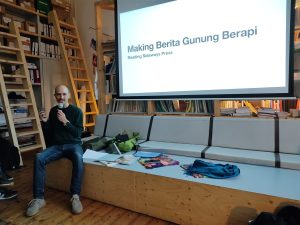
The design of this book is inspired by the early editions of the original Berita Gunung Berapi. Initial conversations about the book’s form were fractious: we didn’t know whether to publish separate Indonesian and English editions, to publish one version in Indonesia and the other here; or what kind of printing device to use: print on demand, off-set or Riso. But, living in Leiden, enabled the design decision to be made. The Leiden University library, it turns out, has copies of the original Berita Gunung Berapi in one of its special collections. And thus, we became inspired, to do as they had done: combine numerous languages; to not hold back with images; to contain drawings, photographs and pull outs. The design by Maria Uthe is both similar to the original; but also clearly her own. The blue folder that our book comes in, relates to the blue folder that readers receive their fragile books in at the Leiden University library. With so many of our reading practices being shaped by digitality and ubiquitous screens, when in doubt about design questions at RSP, we decide to err on materiality.